Segmented Flow Simulation ~ ongoing
The simultaneously flow of gas and liquids in large scale conduits is an established approach to enhance the performance of different working systems in critical conditions. In micro scale, the gas-liquid flow and its advantages are perplexing . We have devised a technique that makes possible to generate common gas-liquid flows on a centrifugal microfluidic platform.
 Several critical parameters that induce different gas-liquid flows and cause the transition between stratified and slug flows are investigated. Different types of flow regimes can be achieved due to rotational speed and geometry specifications. Various flow regimes are shown in Figure 1.
Fig. 1: Different flow regimes
Developing Duplex Chambers For Multi-Step Sequences In Centrifugal Microfluidic Platforms ~2019
Liquids flow control plays a critical role in the designing of microfluidic networks for utilizing in the lab-on-a-chip devices as a modern platform for miniaturizing and automating medical diagnostic tests. In some applications such as immunoassay, it is essential to use different samples and reagent liquids in a series of sequential steps based on the test procedures. Thus far, a number of studies have reported associated methods mostly employing a different kind of the micro-valves. We introduce the concept of a dual-chamber, a passive method for the sequential entrance of any kind of liquids into a chamber
in centrifugal microfluidics. The mechanism relies on the ability of the liquid pumping by employing its rotational potential energy through an abrupt angular deceleration of the containing disk. The model is analyzed theoretically, numerically and experimentally for optimizing the geometrical design to reach to the maximum liquid transfer efficiency. The results show that the presented method has a high ability of precise and efficient liquid transfer in the centrifugal microfluidic platforms through a simple and highly integrated approach. Figure 2 illustrates schematic view (a) and fabricated (b) disk for evaluation of the function of five series of dual-chamber units for sequential liquid loading into the main chamber. The numerically simulated results for three variables consist of the fraction of the transferred liquid, the flow velocity magnitude, and the pressure of the liquid are illustrated in several times in Figure 3. Due to simultaneous effects of the applied inertial and centrifugal forces on the liquid, the liquid transferred is carried out in a layer form. The liquid is flowed to the right side of the secondary chamber because of the applied inertial force. The volume of the final remained liquid shown in ( t = 1.5 s ), is in a good agreement with the experimental results. (DOI: 10.1007/s10404-019-2222-1)


Fig. 2: Illustration of schematic view (a) and fabricated (b)disk
Fig. 3: CFD simulation results of the dual-chamber model
Burst Valve Hydrodynamic Simulation In Microfluidic Disk ~ 2017
The movement of fluids in rotating microchannels is influenced by forces such as centrifugal force, coriolis, capillary, and euler. The effect of each of these forces must be checked in order to improve the fluid motion in the microchannels. The capillary force prevents the flow of fluid from the channel to the reservoir, which causes the phenomenon of capillary valves. The simulation of this phenomenon has been compared with laboratory results. Active and passive valving are two methods for controlling liquid flow. Sacrificial valve is the active one while the burst valve is in passive category. In burst valve the magnitude of centrifugal force and capillary force are key factors for valve action. The burst time is affected by rotational velocity and geometric parameters. Numerical simulations delineate the fluid flow and it decrease the need of fabricating a huge number of disks in order to find the characteristics of burst valve. Figure 4 illustrates that when centrifugal force overcomes capillary force valve will open. By increasing the capillary force the fluid remains at channel and can not move across the valve.
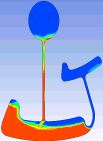
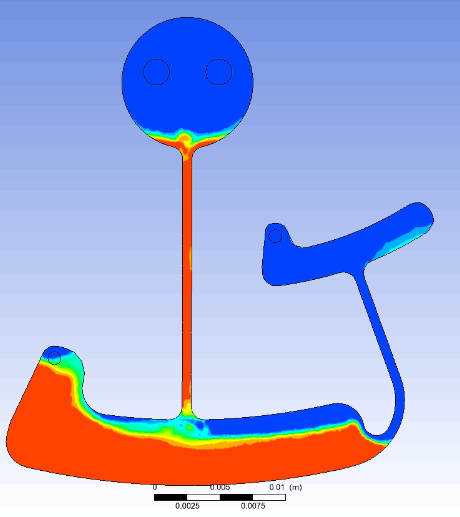
Fig.4: Fluid flow across the valve
SEPEHR Solar Car ~ 2016
The World Solar Challenge is a biennial solar-powered car race which covers 3,022 km (1,878 mi) through the Australian Outback, from Darwin, to Adelaide. The race attracts teams from around the world, most of which are fielded by universities or corporations. It is the most prestigious solar race of the world. Our team was an entirely student run project team that designed and built SEPEHR Solar Car prototype. With four engineering divisions; mechanical, electrical, aerodynamics, and strategy, as well as operations and business divisions. I designed the suspension system (double wishbone) in Catia with my teammate in suspension division. The Catia model is shown in Figure 5. Also the aerodynamics of the solar car is investigated and the simulations in Fluent for calculating drag and lift forces is implemented.(Figure 6). Finally we presented a prototype of the car in a conference which it had impressive feedback on Iranian news channels.
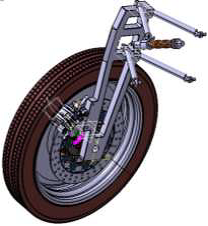

Fig.6: Air flow over car
Fig.5:Suspension Catia model
 Fig.7: Car prototype
Make a free website with Yola